
"There is a sharp jump that we have seen in bookings of EVs... The jump, at least in our case, in just two months, it is about 2 to 2.5 times of what it used to be"

Tata Motors expands its market leadership in India's electric passenger vehicle (ePV) segment, capturing 39 per cent of the market in Q1FY27, while simultaneously strengthening its position as the nation's second-largest carmaker amidst fierce competition and rapid market growth.

TVS Motor Company reported a significant 56.8 per cent year-on-year increase in net profit to 1,036 crore in Q1FY27, driven by record sales volumes, an improved product mix, and robust demand in both domestic and international markets, with management anticipating continued double-digit industry growth.

India's electric passenger vehicle market saw an 87.4 per cent year-on-year increase in FY26, reaching 233,246 units, primarily driven by the mid-size SUV segment (20-30 lakh price bracket), while the entry-level segment (sub-10 lakh) experienced a decline.

Fuel prices have risen by about Rs 7.5 per litre since May 15, as global crude oil prices surged due to the ongoing conflict in West Asia and supply concerns around the Strait of Hormuz.
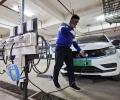
India's electric vehicle (EV) market experienced a significant surge in financial year 2025-26 (FY26), with e4W registrations nearly doubling and e2Ws growing by over 20%, propelled by expanding charging infrastructure, diverse model launches, and accessible financing.

BMW Group India says every Re 1 depreciation in the rupee against the euro trims its profit margin by about 1 per cent, prompting the company to consider further price increases.

India's domestic passenger vehicle sales experienced a robust 24.6 per cent year-on-year increase in June, propelled by favourable government policies like income tax relief and repo rate cuts, alongside resilient rural demand, even as global crude oil prices pose potential cost pressures.

Bajaj Auto plans to increase its annual production capacity by nearly 25 per cent, from around 7 million to over 9 million vehicles, in the coming quarters. This expansion is driven by strong export demand and rapid growth in electric vehicles, which have stretched current capacity across key product segments.

Indian carmakers, including Maruti Suzuki and Kia India, reported robust sales growth in May 2026, with both companies achieving their highest-ever monthly sales despite rising fuel prices. Maruti Suzuki's domestic sales surged to 1,93,535 units, while Kia India recorded 27,586 units, driven by strong demand in mini and compact segments and a shift towards electric and CNG vehicles.

Mahindra & Mahindra (M&M) is largely bullish among analysts following its Q4FY26 results, driven by strong SUV demand, a robust product pipeline, and improving growth visibility across segments, despite near-term margin pressures from rising commodity costs and potential weakness in the tractor cycle.
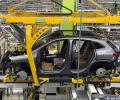
India's total automobile retail sales recorded a significant 9.55 per cent year-on-year growth in May, reaching an all-time high of 25,31,067 units, driven by strong performances in three-wheelers, passenger vehicles, and tractors, despite prevailing heatwave conditions and fuel price pressures.

While GST on ICE vehicles was brought down significantly, for electric cars it remained at 5 per cent.
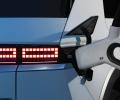
India may see its busiest EV festive season in 2025 with SUVs, luxury cars and scooters set to launch, but rare-earth supply bottlenecks risk delaying rollouts.

Tata Motors emerged as the biggest gainer in the passenger vehicles (PV) market in the second half of FY25, following a GST rate cut in September, achieving the highest growth among major OEMs and overtaking Mahindra & Mahindra in volumes.

But when it comes to e2W, China is the dominant player and had grabbed over 76 per cent share of total e2W imports in 2025 with brands like Yadea, NIU and Sunra dominating the market.

This is the time for India to plan forward fully, with the goal of Atmanirbharata, and energy security. The Persian Gulf is no longer a reliable source, points out Rajeev Srinivasan.

Retail sales of electric passenger vehicles (ePVs) nearly doubled in July 2025, surging 93 per cent year-on-year (Y-o-Y) to 15,528 units, even as overall passenger vehicle (PV) retail volumes declined marginally. In contrast, electric two-wheeler (e2W) sales dropped by 4.3 per cent to 102,973 units, according to the Federation of Automobile Dealers Associations (Fada) data.
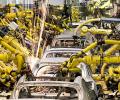
Passenger vehicle sales in India reached a record high of 4.7 million units in FY26, boosted by strong performances from major automakers and the implementation of GST 2.0.
Electric vehicle (EV) sales in India rose 28.60 per cent to 1,80,238 units in June over the period year-ago, driven by massive jump in e-passenger vehicle volumes, Federation of Automobile Dealers' Association (FADA) said in a statement on Tuesday. Electric passenger vehicle sales, as per FADA data, stood at 13,178 units in the previous month compared to 7,323 e-PVs in June 2024, registering a sharp increase of 79.95 per cent year-on-year.

Companies are already diversifying sourcing, raising prices, and reworking operating models as the disruption drags on.

Skoda Auto India, the Czech carmaker that has recently found success with its compact SUV Kylaq, says it remains committed to developing a fully localised electric vehicle (EV). The EV will be manufactured at its Chakan facility for both Indian market and exports.
India's electric vehicle (EV) markets expanded gains in January compared to the year-ago period, as two-wheeler and passenger vehicle sales triggered a shuffle in the competitive landscape, data from an automobile dealers' association showed.

Bajaj Auto reported a significant increase in its consolidated Q4FY26 performance, with profit after tax more than doubling to approximately 3,662 crore, a 103 per cent year-on-year rise, primarily driven by record volumes, an improved product mix, and the strategic consolidation of Bajaj Auto International Holdings AG (BAIHAG).

India's electric passenger vehicle (ePV) market has expanded sharply over the past five years, with registrations rising from just 3,252 units in 2020 to about 170,000 in 2025. Throughout this scale-up, southern states have remained the bedrock of adoption, consistently contributing around one-third of national electric vehicle (EV) registrations - emphasising the region's role as the structural backbone of India's EV transition.

Two-wheeler (2W) major Bajaj Auto on Friday posted its highest ever quarterly revenue and profit during the third quarter of 2025-26 (Q3FY26). Bajaj Auto's consolidated net profit for the quarter grew by 25 per cent year-on-year (Y-o-Y) to Rs 2,749 crore, with the revenue also growing 23 per cent to Rs 16,204 crore.

Maruti Suzuki sold more cars than ever before, earned more money, and saw many first-time buyers choosing small cars again.

The share of first-time luxury customers in BMW's portfolio has risen sharply -- from around 43 per cent in 2024 to nearly 49 per cent in 2025. In some models, the figure is even higher.
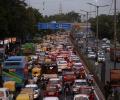
Truck rentals saw a positive momentum across most key trunk routes due to an increased pre-kharif agricultural activity and a resilient manufacturing sector. The Kolkata-Guwahati-Kolkata corridor witnessed a month-on-month (M-o-M) rise of 2.4 per cent, while the Mumbai-Chennai-Mumbai route grew by 1.9 per cent and the Delhi-Hyderabad-Delhi route saw a 1.6 per cent increase in truck rentals, said June edition of the Shriram Mobility Bulletin.

Automobile retail sales across the domestic market witnessed a 21 per cent year-on-year increase in the 42-day festive season led by record registrations of passenger vehicles and two-wheelers aided by GST rejig enabled drop in prices across segments, dealer' body FADA said on Friday.

Is the parabolic rise in silver running out of steam or just getting started? Ramalingam Kalirajan offers his take on if you should invest in silver now?

With gains of over 28 per cent, Hero MotoCorp has emerged as the best-performing largecap automotive stock over the past three months. The rally has been driven by an improved outlook for the rural segment, higher demand during the ongoing festival season, and rising affordability following cuts in goods and services tax (GST) rates.

India's macroeconomic health is in a "relative goldilocks situation", and although the risk of higher landed oil prices, due to insurance cost surges and closure of choke points due to the brief Israel-Iran war, has receded, it is "too soon to sound the 'all clear' for the rest of the year", the Finance Ministry said on Friday.

After a record-breaking year, India's automobile industry is entering 2026 on a relatively strong footing, with sales growth expected in the 6-8 per cent range. The outlook is underpinned by policy support, including GST rationalisation, easing monetary conditions, and income tax relief, which together are likely to improve affordability and sustain consumer demand across vehicle segments.

The EV industry is at an inflection point and batteries will play a critical role ahead -- batteries and related components typically constitute 35-45 per cent of an EV's costs.

Sluggish urban demand, a high base effect, and weak sales of hatchbacks and sedans weigh down passenger vehicle sales in FY25.

Auto majors Maruti Suzuki, Tata Motors and Mahindra & Mahindra reported robust sales in September as reduced price tags owing to GST rationalisation led to record demand in the Navaratri period. The month also saw Tata Motors and Mahindra & Mahindra settling at number two and three positions, respectively in vehicle wholesales ahead of Hyundai Motor India.

Given the stronger rural activity, and potential goods and services tax (GST) impact, investors are bullish on the two-wheeler (2W) segment. In August, dealers in the domestic market picked up 11 per cent more 2Ws year-on-year (Y-o-Y), despite only 2 per cent growth in retail registrations. This indicates inventory stocking ahead of the festival season. Export trends were good. TVS Motor and Royal Enfield may have gained domestic market share.
In 2024 alone, South India saw the highest rise in sales in the luxury segment, with Tamil Nadu reportedly registering a 19.3 per cent increase in premium car registrations from 2022-23

Major two-wheeler manufacturers in India witnessed a double-digit increase in domestic sales in October, driven by the festival fervour.
